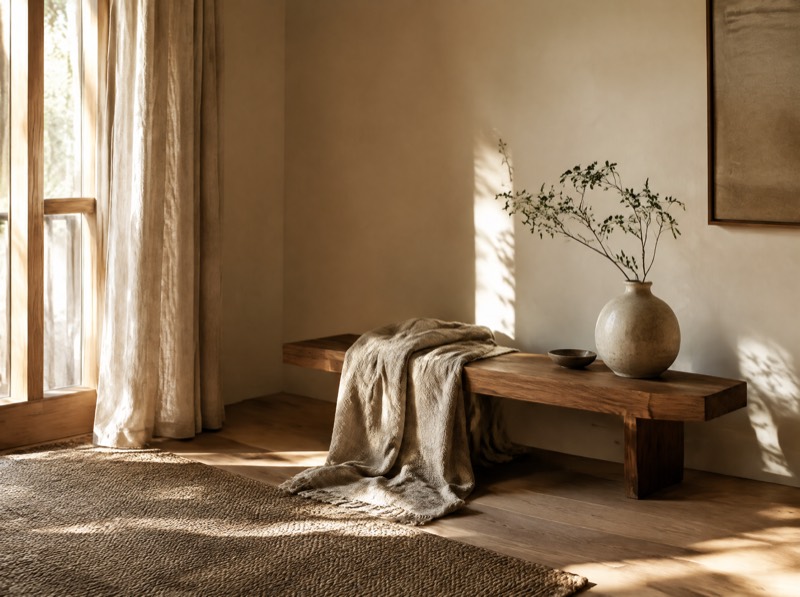
Colour gets all the attention, but texture is what a room actually feels like. Five materials that quietly settle a space.
We talk about rooms in terms of colour, but we live in them in terms of texture. A room can have a perfect palette and still feel cold; another can be almost monochrome and feel like a deep breath. The difference is what your hands and eyes find when they land.
1. Linen, slightly rumpled
Linen is the great de-formaliser. A linen cushion cover, a throw over the arm of a chair, curtains that move — linen signals that a room is used rather than staged. Let it crease. Ironing linen is a hobby, not a requirement.
2. Wool, chunky and honest
A chunky wool throw adds weight, which is the texture equivalent of a low voice. Wool also absorbs sound, which is why rooms with textiles feel quieter. Choose undyed or naturally dyed wool where you can; the irregularities are the point.
3. Wood, worn smooth
A wooden bowl, a chopping board left out, a stool that has been sat on for twenty years. Wood warms a room in a way no painted surface can, and the wear marks are a record rather than a flaw. One good wooden object per room is plenty.
4. Ceramic, matte and imperfect
Glossy ceramic reflects; matte ceramic absorbs. A hand-thrown mug with a slightly uneven rim gives the eye somewhere soft to rest. Group two or three in related tones rather than scattering them — texture works best in clusters.
5. Paper and plants
Books, a stack of magazines, the leaves of a single plant near a window. Paper brings a fine, dry texture that balances all the softness, and a plant brings movement. Neither needs to be styled. They just need to be there.
The rule underneath
Choose textures you would want to touch with your eyes closed, and limit yourself to three per room. Calm is not the absence of things. It is the presence of things that agree with each other.